Wednesday, April 20, 2016
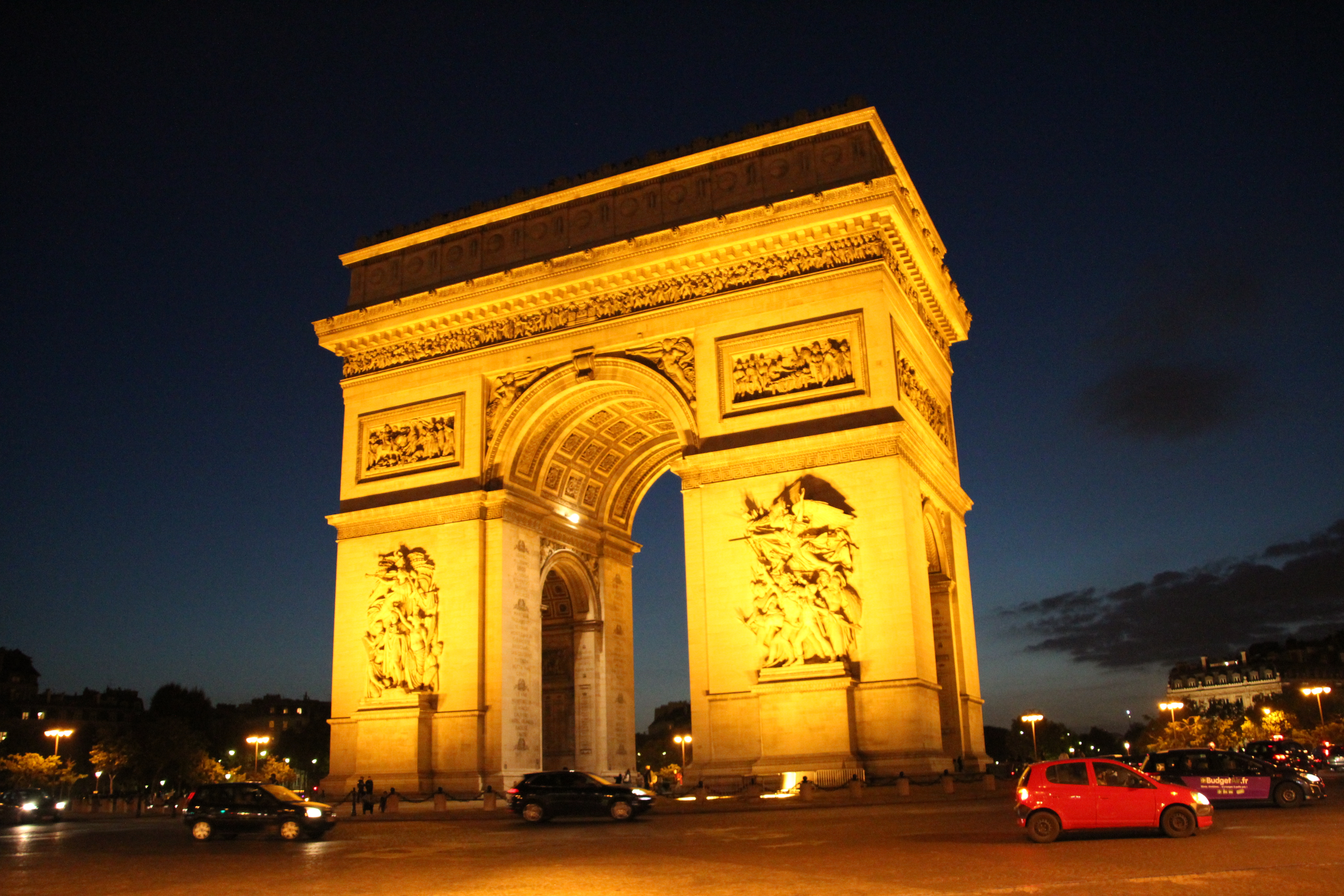
Arc de triomphe
The Arc is located on the right bank of the Seine at the centre of a dodecagonal configuration of twelve radiating avenues. It was commissioned in 1806 after the victory at Austerlitz by Emperor Napoleon at the peak of his fortunes. Laying the foundations alone took two years and, in 1810, when Napoleon entered Paris from the west with his bride Archduchess Marie-Louise of Austria, he had a wooden mock-up of the completed arch constructed. The architect, Jean Chalgrin, died in 1811 and the work was taken over by Jean-Nicolas Huyot. During the Bourbon Restoration, construction was halted and it would not be completed until the reign of King Louis-Philippe, between 1833 and 1836, by the architects Goust, then Huyot, under the direction of Héricart de Thury. On 15 December 1840, brought back to France from Saint Helena, Napoleon's remains passed under it on their way to the Emperor's final resting place at the Invalides.[7] Prior to burial in the Panthéon, the body of Victor Hugo was displayed under the Arc during the night of 22 May 1885.

Sacre Coeur
The inspiration for Sacré Cœur's design originated on September 4, 1870, the day of the proclamation of the Third Republic, with a speech by Bishop Fournier attributing the defeat of French troops during the Franco-Prussian War to a divine punishment after "a century of moral decline" since the French Revolution, in the wake of the division in French society that arose in the decades following that revolution, between devout Catholics and legitimist royalists on one side,[3] and democrats, secularists, socialists and radicals on the other. This schism in the French social order became particularly pronounced after the 1870 withdrawal of the French military garrison protecting the Vatican in Rome to the front of theFranco-Prussian War by Napoleon III,[4] the secular uprising of the Paris Communeof 1870-1871, and the subsequent 1871 defeat of France in the Franco-Prussian War.
Notre Dame de Paris
Notre-Dame de Paris (IPA: [nɔtʁə dam də paʁi](French  (help·info)) ; French for "Our Lady of Paris"), also known asNotre-Dame Cathedral or simply Notre-Dame, is a medieval Catholic cathedral on the eastern half of the Île de la Citéin the fourth arrondissement of Paris, France.[3] The cathedral is widely considered to be one of the finest examples ofFrench Gothic architecture, and it is among the largest and most well-known church buildings in the world. Thenaturalism of its sculptures and stained glass are in contrast with earlier Romanesque architecture.
(help·info)) ; French for "Our Lady of Paris"), also known asNotre-Dame Cathedral or simply Notre-Dame, is a medieval Catholic cathedral on the eastern half of the Île de la Citéin the fourth arrondissement of Paris, France.[3] The cathedral is widely considered to be one of the finest examples ofFrench Gothic architecture, and it is among the largest and most well-known church buildings in the world. Thenaturalism of its sculptures and stained glass are in contrast with earlier Romanesque architecture.
As the cathedral of the Archdiocese of Paris, Notre-Dame is the parish that contains the cathedra, or official chair, of the Archbishop of Paris, currently Cardinal André Vingt-Trois.[4] The cathedral treasury is notable for its reliquary which houses some of Catholicism's most important first-class relics including the purported Crown of Thorns, a fragment of the True Cross, and one of the HolyNails.

la louvre
The museum is housed in the Louvre Palace, originally built as a fortress in the late 12th century under Philip II. Remnants of the fortress are visible in the basement of the museum. The building was extended many times to form the present Louvre Palace. In 1682, Louis XIV chose the Palace of Versailles for his household, leaving the Louvre primarily as a place to display the royal collection, including, from 1692, a collection of ancient Greek and Roman sculpture.[2] In 1692, the building was occupied by the Académie des Inscriptions et Belles Lettres and the Académie Royale de Peinture et de Sculpture, which in 1699 held the first of a series of salons. The Académie remained at the Louvre for 100 years.[3] During the French Revolution, the National Assembly decreed that the Louvre should be used as a museum to display the nation's masterpieces.
Eiffel tower
The tower is 324 metres (1,063 ft) tall, about the same height as an 81-storey building, and the tallest structure in Paris. Its base is square, measuring 125 metres (410 ft) on each side. During its construction, the Eiffel Tower surpassed the Washington Monument to become the tallest man-made structure in the world, a title it held for 41 years until the Chrysler Building in New York City was finished in 1930. Due to the addition of a broadcasting aerial at the top of the tower in 1957, it is now taller than the Chrysler Building by 5.2 metres (17 ft). Excluding transmitters, the Eiffel Tower is the second-tallest structure in France after the Millau Viaduct.
 |
| la tour eiffel |
Wednesday, February 10, 2016
Wednesday, January 13, 2016


Subscribe to:
Posts (Atom)